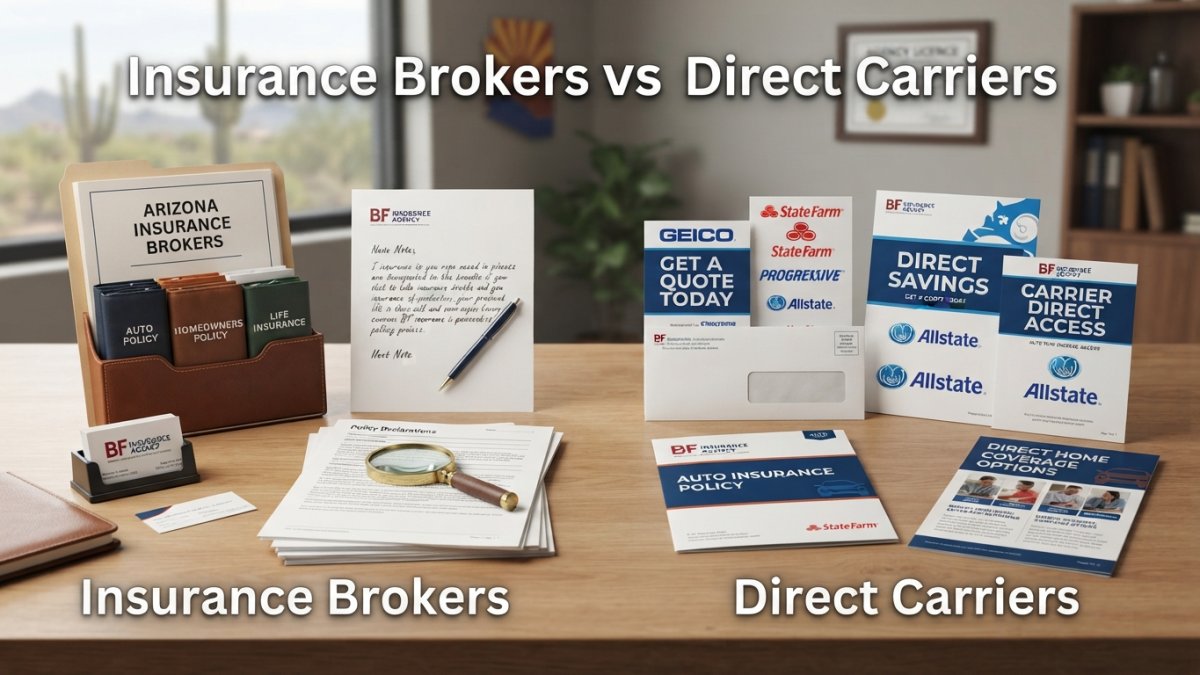
 comparison
Gordon Insurance vs Canyon State Insurance
Table of Contents
- Gordon Insurance vs Canyon State Insurance: Quick Comparison
- Service Model and Local Support: Independent Agents in Arizona
- Arizona Auto Insurance Requirements: What Both Agencies Must Cover
- Benefits of Bundled Insurance Plans for Arizona Households
- Claims Handling and Customer Service: Where Each Agency Stands
- Pricing Factors and Coverage Options in Arizona
- How BF Insurance Agency Compares for Arizona Families
- Conclusion: Choosing the Right Agency for Your Needs
- Frequently Asked Questions
Last Updated: October 4, 2026
Gordon Insurance vs Canyon State Insurance: Quick Comparison
Choosing between Gordon Insurance and Canyon State Insurance comes down to one question: do you want a captive agent tied to one carrier's products, or an independent broker who can shop multiple carriers for you? That distinction shapes your premium rates and how your claims get handled. This comparison breaks down service models, Arizona requirements, bundling benefits, and claims handling.
| Feature | Captive Agency Model | Independent Broker Model |
|---|---|---|
| Carrier access | Single carrier | Multiple carriers |
| Rate shopping at renewal | Limited | Yes |
| Claims advocacy | Carrier-side support | Policyholder-side support |
| Bundling flexibility | Carrier's own products | Cross-carrier bundles |
| Best for | Brand loyalty | Comparison shoppers |
Service Model and Local Support: Independent Agents in Arizona
Independent insurance agents in Arizona work for you, not for a single insurance company.

At renewal, an independent broker with multiple carriers can re-shop your policy annually, while a captive agent works within one company's underwriting criteria and rate filings.
Local support also means someone who understands Arizona-specific risks: monsoon season, wildfire exposure in northern communities, and the state's minimum coverage requirements.
Arizona Auto Insurance Requirements: What Both Agencies Must Cover
Arizona auto insurance requirements set a floor, not a ceiling. State law requires liability coverage, but those minimums rarely cover the full cost of a serious accident.
Arizona operates under a tort system, meaning the at-fault driver (or their insurer) pays for damages, making adequate liability limits critical.
What the state minimums actually require
Arizona's financial responsibility law requires drivers to carry liability coverage at these minimum limits:
- $25,000 for bodily injury or death of one person in any one accident
- $50,000 for bodily injury or death of two or more persons in any one accident
- $15,000 for injury to or destruction of property of others in any one accident
These are commonly written as 25/50/15 and have not kept pace with the cost of a modern medical claim or a new vehicle. A single hospital stay can exceed the $25,000 per-person limit, and a newer truck or SUV can exceed the $15,000 property damage limit quickly. When damages exceed your limits, the at-fault driver can be personally exposed to the difference.
Where the agency model changes the outcome
The statutory minimum is identical no matter who writes your policy. What differs is how each agency model helps you decide how far above the minimum to go, and how it responds when your needs change.
A captive agent can only present that carrier's limit options and endorsements. An independent broker can quote the same 25/50/15 baseline across multiple carriers and show you what 100/300/100 or 250/500/250 actually costs at each one.
Additional coverages worth pricing
Beyond liability, Arizona drivers commonly add:
- Uninsured/underinsured motorist (UM/UIM): Arizona has a significant share of uninsured drivers, and UM/UIM responds when the at-fault driver has no coverage or too little. Arizona insurers must offer UM/UIM, and you must reject it in writing to decline it.
- Medical payments (MedPay): Pays medical bills for you and your passengers regardless of fault, up to the limit you select.
- Collision and comprehensive: Required by most lenders and leases; also the coverage that responds to monsoon hail, flash flooding, and wildlife strikes.
How to verify an agency is handling this correctly
Ask any agent three questions before you bind a policy:
- What limits are you quoting me, and why those numbers?
- Did you price UM/UIM and MedPay, or did you leave them off to lower the quote?
- If my situation changes, new teen driver, new vehicle, move within the state, how do we revisit these limits?
A good agent walks you through deductible levels, coverage limits, and policy exclusions in plain language. Arizona Department of Insurance and Financial Institutions consumer resources publishes guidance on required coverage and consumer protections, which is worth reviewing before you sign anything.
Benefits of Bundled Insurance Plans for Arizona Households
Bundling auto and home insurance is one of the most reliable ways Arizona families reduce their total premium.
The benefits of bundled insurance plans go beyond the discount. You get one renewal date, one point of contact, and fewer moving parts when something goes wrong.
- Single deductible coordination: Some carriers waive or reduce one deductible when both policies are with them.
- Simplified billing: One payment, one statement, less chance of a lapse.
- Stronger retention discounts: Many carriers reward long-term bundled customers at renewal.
Independent brokers have an edge here. We can compare bundle pricing across multiple carriers rather than presenting one company's bundle as the only option.
Claims Handling and Customer Service: Where Each Agency Stands
Claims handling is where the agency model shows its real value. Below is the step-by-step process, where a captive agent and an independent broker diverge, and what to ask before you ever need to file.
The claims process, step by step
Whether you are with Gordon Insurance, Canyon State Insurance, or any other agency, the mechanical steps are similar:
- Report the loss. You call the carrier's claims line, file through its app or portal, or call your agent, who reports it for you. The first notice of loss creates the claim number.
- Assignment. The carrier assigns an adjuster, an employee adjuster or an independent adjuster contracted for a storm or catastrophe event.
- Inspection and documentation. For auto: photos, a repair estimate, often a body shop inspection. For home: photos, a contractor estimate, sometimes a field inspection of the roof, siding, or interior damage.
- Coverage determination. The adjuster applies your policy language, limits, deductibles, exclusions, to the documented loss.
- Payment or denial. The carrier pays covered damages minus your deductible, or issues a denial letter explaining the basis.
- Dispute, if needed. You can request a re-inspection, invoke the appraisal clause if your policy has one, or file a complaint with the state insurance department.
Where the agency model actually changes the outcome
Steps 1 through 6 are the same on paper. The difference is who is in your corner during steps 4 through 6.
An independent broker can re-shop your policy at renewal if the claims experience was poor, without you having to start over with a new agent.
What after-hours and catastrophe response really looks like
Most claims are not filed at 2 p.m. on a Tuesday. They are filed after a monsoon microburst, a hailstorm in the East Valley, or a wildfire evacuation in the northern communities. That is when the difference between a local agency and a national call center becomes concrete.
Ask any agent: "What is your after-hours process, and who actually answers when I call at 9 p.m. after a storm?"
Questions to ask before you need to file
- How do you handle a claim where the adjuster's estimate is lower than my contractor's?
- Have you ever helped a client challenge a denial, and what was the outcome?
- Do you have a preferred body shop or restoration contractor network, and am I required to use it?
Pricing Factors and Coverage Options in Arizona
Pricing factors for Arizona insurance fall into a few buckets: your risk profile, your coverage selections, and the carrier's underwriting criteria. Two neighbors with identical homes can pay very different premiums because of claims history, credit-based insurance scores, and the coverage limits they chose.
Key factors that move your premium:
- Deductible levels: A higher deductible lowers your premium but increases your out-of-pocket cost at claim time.
- Coverage limits: Raising liability limits costs more but protects more of your assets.
- Vehicle or home age: Older structures and vehicles may carry different rating factors.
Policy renewal is your annual checkpoint: last year's rate isn't this year's rate. An independent broker re-shops at renewal; a captive agent works within one carrier's new filings.
How BF Insurance Agency Compares for Arizona Families
BF Insurance Agency operates as an independent broker serving Arizona residents and communities, quoting across multiple carriers rather than representing a single company.
What we bring to the table:
- Insurance plans designed specifically for Arizona households
- Bundled solutions tailored to your individual needs
- Expert advice and guidance through complex coverage decisions
- Personalized coverage that fits your lifestyle and budget
We also help clients meet state-mandated insurance requirements without overpaying for coverage they don't need. National Association of Insurance Commissioners guidance on choosing an agent offers a useful framework for evaluating any agency before you commit.
If you've been with the same agent for years and your premiums keep climbing, it's worth getting a second opinion. That's not disloyalty; it's due diligence.
Conclusion: Choosing the Right Agency for Your Needs
The right agency for your family answers your questions clearly and picks up the phone when you have a claim. Gordon Insurance vs Canyon State Insurance is a fair comparison, but the deeper question is whether a captive or independent model serves you better. At BF Insurance Agency, we built our practice around independent representation, tailored Arizona coverage, and bundled plans designed to save you money while meeting state requirements.
Frequently Asked Questions
What factors should I consider when comparing insurance agencies in Arizona?
Focus on licensing, claims handling reputation, local presence, and whether the agency represents multiple carriers or just one. Independent agents in Arizona can quote from several insurers, which helps you find coverage that fits your situation. Check the Arizona Department of Insurance and Financial Institutions to verify licensing. Also ask about response times, bundling options, and how they handle claims. The right agency explains your options clearly without pushing you toward a single plan.
How do independent insurance agents in Arizona differ from captive agents?
Independent agents work with multiple insurance companies, so they can compare policies and prices across carriers. Captive agents represent one company only, which limits your options. For Arizona residents, independent agents are not tied to a single insurer's pricing. They also help you understand Arizona auto insurance requirements and can adjust coverage as your needs change.
Are there specific insurance requirements for drivers in Arizona?
Arizona requires drivers to carry liability insurance that meets minimum coverage limits set by state law. These limits apply to bodily injury and property damage. If you lease or finance a vehicle, your lender may require additional coverage like collision and comprehensive. An independent agent can explain the exact requirements for your situation and help you meet them without paying for coverage you do not need. Always verify current limits with the Arizona Department of Insurance and Financial Institutions.
What are the benefits of bundled insurance plans for Arizona families?
Bundling auto and home insurance with one agency often lowers your total premium because many carriers offer multi-policy discounts. It also simplifies billing and claims since you deal with one agent for both policies. For Arizona families, bundling can close coverage gaps and ensure both policies renew together. The actual savings depend on your vehicles, home value, and claims history, so ask your agent for a side-by-side quote before deciding.
How can I verify the licensing status of an insurance agency in Arizona?
Visit the Arizona Department of Insurance and Financial Institutions website and use their licensee search tool. You can look up any agency or agent by name or license number. The record shows whether the license is active, what lines of insurance they can sell, and if there are any disciplinary actions. This step takes a few minutes and confirms you are working with a legitimate, regulated agency before sharing personal information or making a payment.