 ultimate-guide
What Are Arizona's Minimum Auto Insurance Requirements?
Last Updated: October 25, 2026
Quick Summary
Arizona auto insurance requirements are 25/50/15: $25,000 for bodily injury to one person, $50,000 for bodily injury to two or more people in one accident, and $15,000 for property damage. These liability limits are the legal floor for financial responsibility and do not cover your own car or injuries.
- The three liability limits do not stack; the per-accident cap limits total bodily injury payout.
- Minimum liability coverage pays others and excludes your own car, injuries, and rental.
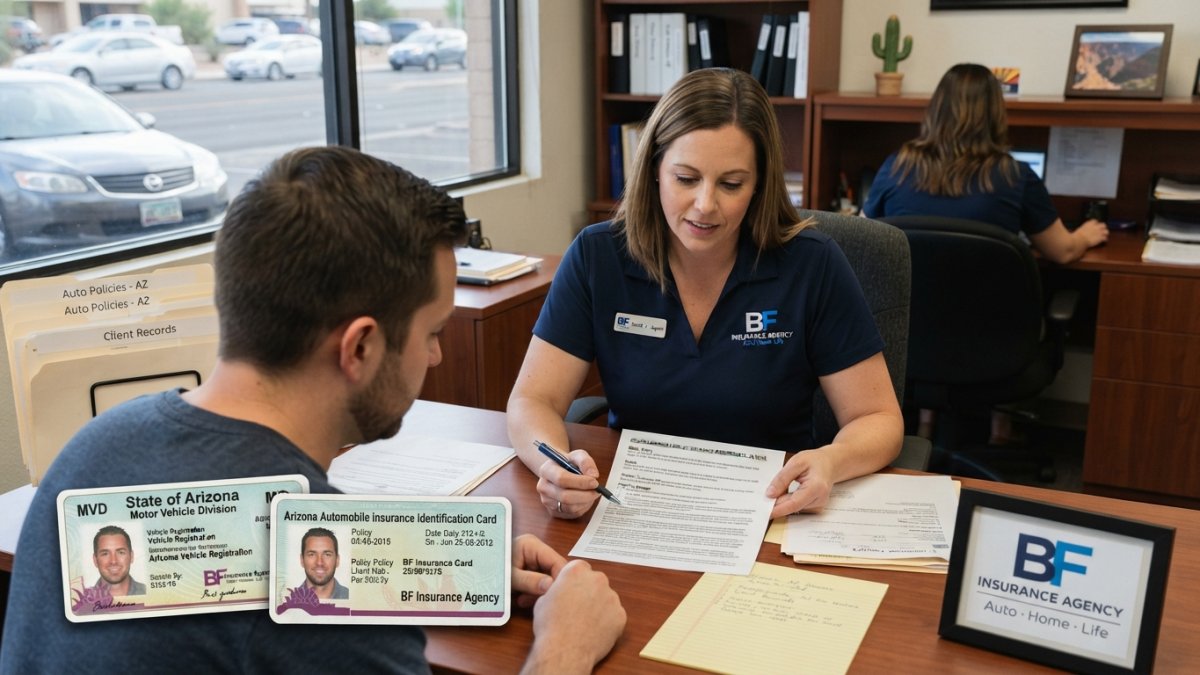
- Arizona accepts paper insurance cards or electronic proof shown on a phone.
- A canceled policy can suspend your registration even if the car was never driven.
- Lenders on financed vehicles routinely require collision and comprehensive coverage.
Table of Contents
- Arizona Minimum Car Insurance Requirements: The 25/50/15 Rule
- Arizona Proof of Insurance Requirements: What Counts and When
- Arizona Auto Insurance Penalties for No Insurance
- Arizona Car Insurance for Financed Vehicles: Lender Requirements on Top of State Minimums
- Legal Minimums vs. Coverage That Actually Protects You
- Alternatives to a Standard Arizona Auto Insurance Policy
- Get a Quote That Matches Your Arizona Coverage Needs
- Frequently Asked Questions
Arizona Minimum Car Insurance Requirements: The 25/50/15 Rule
Arizona auto insurance requirements start with three numbers: 25/50/15. Every driver who registers a vehicle in the state must carry liability coverage at or above those limits, and understanding what each figure pays for is the difference between a minor inconvenience and a financial crisis after a crash. At BF Insurance Agency, we help Arizona drivers understand these limits, as the confusion is almost always the same: people know the numbers exist but not what happens when a claim exceeds them.
Here is the rule in plain terms. Arizona minimum car insurance requirements are the lowest liability limits the state will accept on a registered vehicle: $25,000 for bodily injury to one person, $50,000 for bodily injury to two or more people in one accident, and $15,000 for property damage. The Arizona Department of Transportation and the Arizona Department of Insurance and Financial Institutions both treat these as the legal floor for financial responsibility, not a recommendation.
How the Three Liability Limits Work in a Real Crash
The three limits do not stack the way most people assume. Imagine you cause a crash that injures two people. One person's medical bills reach $40,000; the other's reach $20,000. Your per-person limit caps the first claim at $25,000, and your per-accident limit caps the total bodily injury payout at $50,000.
Property damage works the same way. Hit a new truck and cause $30,000 in damage, and your $15,000 property damage limit leaves a substantial gap you are personally responsible for.
What Minimum Coverage Does Not Pay For
Minimum liability coverage pays other people. It does not pay for your own car, your own injuries, or a rental while yours is in the shop. Uninsured motorist coverage, collision coverage, and comprehensive coverage are all separate purchases in Arizona. That distinction matters: a driver who buys only the state minimum has met the legal requirement and still has no protection for their own vehicle.
Arizona Proof of Insurance Requirements: What Counts and When
Arizona drivers must be able to show proof of insurance whenever a law enforcement officer requests it, after an accident, and at vehicle registration or title transfer. The Arizona Department of Transportation recognizes electronic proof, so a saved PDF or insurer app screen satisfies the requirement.

Coverage must stay active for as long as the vehicle is registered, even if you are not driving it. Arizona verifies insurance electronically through insurer reporting, so a canceled policy surfaces quickly.
Arizona Auto Insurance Penalties for No Insurance
Driving uninsured in Arizona carries consequences that escalate with each violation, and the penalties attach to both the driver and the vehicle. Under the state's financial responsibility law, a first conviction for driving without insurance is a civil traffic violation.
The registration side is where many drivers get surprised. Arizona verifies insurance electronically through insurer reporting to the Motor Vehicle Division, so a canceled policy surfaces without a traffic stop.
What Happens After a Lapse and How to Reinstate
Reinstatement is a sequence, not a single payment. A practical order to consider:
- Secure active coverage first. Buy a new policy and get the declarations page showing the effective date and the vehicle listed. Do not pay the state before coverage is bound, the MVD needs an active policy on record to clear the suspension.
- Confirm what the MVD is actually asking for. Log in to the MVD's online services or call to see whether the suspension is on the registration, the license, or both, and whether an SR-22 filing is required. The exact reinstatement fee and any SR-22 obligation depend on the violation history, so confirm the amount with the Arizona MVD before you pay.
- Pay the reinstatement fee and submit proof. The MVD will not release the suspension until the fee is paid and the insurer's electronic filing shows active coverage. Keep the receipt and the declarations page together.
- Keep continuous proof. A second lapse within the lookback period draws stricter requirements, and an SR-22 typically must stay on file for a set period, often multiple years, with no gap. A cancellation during that window restarts the problem.
The practical takeaway: the fee is the smallest part of the problem. The real cost is the time between the lapse and the MVD clearing the record, and the stricter filing requirements that follow a second lapse.
Arizona Car Insurance for Financed Vehicles: Lender Requirements on Top of State Minimums
A financed or leased vehicle answers to two masters: the state and the lender. State minimums satisfy Arizona law, but lenders routinely require collision and comprehensive coverage with a maximum deductible, plus proof that the lender is listed as loss payee. Skip those and the lender can force-place its own, far more expensive coverage onto your loan.
Read our breakdown of leased car insurance coverage requirements if your vehicle is leased rather than financed. And if you are weighing protection for the gap between your loan balance and the car's value, our comparison of gap insurance vs new car replacement coverage explains which fits your situation.
Legal Minimums vs. Coverage That Actually Protects You
Meeting the legal requirement and being adequately protected are two different goals. Minimum limits were set as a floor for financial responsibility, not as a measure of what a serious injury or a new vehicle actually costs. A crash involving multiple people or a late-model car can blow past 25/50/15 in seconds, and the at-fault driver absorbs the excess personally.
Higher liability limits, uninsured motorist coverage, and medical payments coverage close those gaps. If you are unsure where to land, our guide on how much liability insurance you need walks through the decision. The honest answer for most families: the state minimum is the cheapest legal option, not the safest one.
Alternatives to a Standard Arizona Auto Insurance Policy
A standard auto policy is the most common way to satisfy Arizona's financial responsibility law, but it is not the only way. The state recognizes alternative filings for drivers and entities that do not fit a conventional policy, and understanding how each one works matters because an alternative filing still leaves you personally exposed in a serious crash.
The alternatives generally fall into three buckets:
- Cash deposit or surety bond filed with the state. Instead of buying a policy, the driver posts a deposit or obtains a bond through a surety company and files it with the MVD. The amount is tied to the state's minimum limits, and the filing must stay in force for as long as the vehicle is registered. The trade-off: your money or the bond is committed, and a claim can reach it directly.
- Self-insurance for qualifying entities. Larger organizations with fleets and a demonstrated financial base can apply to self-insure rather than buy a commercial policy. This is an entity-level option, not something an individual driver typically uses, and it requires state approval and ongoing proof of financial strength.
- Non-standard or specialty policies. For drivers with a spotty record, an older vehicle, or a gap in coverage history, a specialty carrier writes a policy that meets the legal minimum but prices for the risk. These are ordinary insurance policies, just not the standard-market kind, and they are the most common route for drivers who cannot get a standard policy.
Our guide to finding insurance for non-standard drivers covers how those policies differ in price and eligibility. The point most guides miss is that the choice between a standard policy and an alternative is not just about price, it is about who absorbs the excess when a claim exceeds the minimum limits. With a standard policy, the insurer defends and pays up to the limits. With a bond or deposit, the money is yours and the exposure is yours.
| Situation | Best Fit | Watch Out For |
|---|---|---|
| Clean record, newer car | Standard policy with higher limits | Minimum limits leave you exposed |
| Financed or leased vehicle | Standard policy plus collision and comprehensive | Lender force-placed coverage costs more |
| Non-standard driving history | Non-standard or specialty policy | Higher premiums, fewer add-ons |
| Vehicle stored, rarely driven | Confirm continuous coverage rules | A lapse can suspend registration |
| Fleet or entity with financial base | Self-insurance application through the state | Approval and ongoing proof required |
Get a Quote That Matches Your Arizona Coverage Needs
The gap between legal and adequate is where many Arizona drivers find themselves exposed, and it is entirely avoidable with the right limits in place.
We help you meet state-mandated requirements, tailor coverage to financed or leased vehicles, and review bundling options that may reduce what you pay overall. Get your Arizona auto insurance quote online and see what coverage that actually fits looks like.
Get started with BF Insurance Agency and drive with protection tailored for your life, not just the legal minimum.
Frequently Asked Questions
What are Arizona's minimum auto insurance requirements?
Arizona requires liability coverage of 25/50/15: $25,000 for bodily injury to one person, $50,000 for bodily injury to two or more people in one accident, and $15,000 for property damage. These are the legal minimums for any registered vehicle. Arizona does not require uninsured or underinsured motorist coverage, though insurers must offer it and you can reject it in writing. Many drivers buy higher limits because a serious crash can exceed these amounts quickly.
What happens if you drive without insurance in Arizona?
Driving uninsured in Arizona can lead to fines, license suspension, and registration suspension. If you are caught without proof of insurance during a traffic stop or after a crash, penalties escalate for repeat offenses. A lapse in coverage can also be reported by your insurer to the state, which may trigger a registration suspension until you show proof of a new policy. Reinstatement usually involves paying fees and filing proof of future coverage.
How can you prove you have auto insurance in Arizona?
Arizona accepts a paper insurance card or electronic proof on your phone. Your insurer issues an insurance card listing your policy number, coverage limits, and effective dates. Keep it in the vehicle or accessible on your phone. During a traffic stop, registration renewal, or accident, you may be asked to show it. If your policy lapses, your insurer notifies the state, and you may need to file proof of a new policy to keep your registration active.
Do I need different auto insurance for a financed or leased vehicle?
Yes. Lenders and leasing companies typically require collision and comprehensive coverage on top of Arizona's liability minimums, because they want the vehicle itself protected. Your loan or lease agreement will state the required deductible and coverage levels. If you drop collision or comprehensive before the loan is paid off, the lender may buy force-placed insurance and add the cost to your loan. Review your contract before choosing limits.
Is minimum car insurance enough to protect me in Arizona?
Arizona's 25/50/15 minimums cover only a limited amount of damage. A single hospital stay for a serious injury can exceed $25,000, and a two-car crash with multiple injuries can exceed $50,000. If damages exceed your limits, you are personally responsible for the difference. Many Arizona drivers choose higher liability limits and add uninsured motorist coverage, since Arizona has a significant number of uninsured drivers on the road.
What should I do if my Arizona auto insurance policy lapses?
Contact your insurer or a new agent immediately to start a new policy. In Arizona, a lapse can lead to a registration suspension, and you may need to pay a reinstatement fee and file proof of coverage with the state. Driving during a lapse risks fines and further penalties. If you are between policies, ask about short-term or non-owner coverage to keep continuous insurance on record, since gaps can also raise your future premiums.
Arizona's minimum limits are easy to meet and easy to outgrow. If you have never checked whether your current policy would cover a serious crash, that is the conversation worth having. BF Insurance Agency offers personalized coverage reviews, bundled auto and home solutions, and guidance on meeting state requirements without overpaying. Get started with BF Insurance Agency and build a policy that protects your family, your vehicle, and your finances.