 listicle
9 Arizona Auto Insurance Coverages Worth Knowing
Quick Summary
Arizona requires drivers to carry liability coverage, but the state minimum is only a floor. Most drivers should also consider uninsured motorist coverage, collision and comprehensive, and higher liability limits to protect savings after a serious crash. Arizona is an at-fault state, so the auto insurance coverage you choose determines who pays.
- Arizona is a financial responsibility state, so you must be able to show proof of coverage before driving.
- The state minimum liability limits do not cap what you can be sued for after a serious crash.
- Uninsured motorist coverage protects you when the at-fault driver has no or too little insurance.
- Full coverage combines liability with collision and comprehensive, and lenders often require it.
- Ask every insurer to quote the same limits and deductibles so the premiums are truly comparable.
Table of Contents
- Arizona Auto Insurance Requirements: The Minimum You Must Carry
- Liability Coverage: Bodily Injury and Property Damage Explained
- Uninsured Motorist Coverage Arizona Drivers Should Not Skip
- Arizona Full Coverage Car Insurance: Collision, Comprehensive and Costs
- Heat, Monsoon Storms and Claims: Coverage That Fits Arizona Weather
- Special Situations: Rideshare Driving, SR-22 Filings and Leased Cars
- How to Compare Arizona Auto Insurance Quotes and Pick Your Coverage
- Step 1: Write down your coverage targets before you shop
- Step 2: Gather the same information for every quote
- Step 3: Compare on more than premium
- Step 4: Ask about discounts, and verify they apply
- Step 5: Handle high-risk and SR-22 situations separately
- Step 6: Review before you bind
- Common mistakes to avoid
- Get Your Arizona Auto Insurance Quote From BF Insurance Agency
- Frequently Asked Questions
Arizona drivers face a choice that most of them never fully think through: the state sets a legal floor for auto insurance coverage, but that floor is rarely enough to protect you after a serious crash.
Arizona is a financial responsibility state, which means you must carry proof of coverage before you drive. The coverages below range from legally required to strongly recommended, and each one answers a different risk.
Last Updated: November 1, 2026
Arizona Auto Insurance Requirements: The Minimum You Must Carry
Arizona is a financial responsibility state, which means you must be able to show proof of coverage whenever you drive. The state sets a legal floor for liability coverage, and every policy sold here has to meet it.
Those minimum limits are the baseline, not a recommendation. They exist so that a driver who causes a crash has at least some money available to pay the other person's medical bills and vehicle damage.
What happens if you drive uninsured
Driving without the required coverage in Arizona is not a minor paperwork problem. Penalties for driving uninsured can include suspension of your registration and license and a requirement to file proof of future financial responsibility before you can drive legally again.
Before you reduce limits, ask your agent to quote the difference between the state minimum and the next tier up so you can compare the cost with the protection it adds.
Minimum limits vs. what most drivers actually carry
Meeting the legal minimum keeps you lawful, but it does not make you well protected. A practical approach is to treat the state minimum as the floor and then decide, coverage by coverage, how much more protection your assets and income justify. The sections below walk through liability, uninsured motorist, collision, and comprehensive so you can see where the minimum leaves gaps and where an upgrade earns its premium.
Liability Coverage: Bodily Injury and Property Damage Explained
Liability coverage pays for injuries and damage you cause to other people. It has two parts. Bodily injury liability covers medical bills, lost wages and pain and suffering for people you injure. Property damage liability covers repairs or replacement for another person's vehicle, fence, or building.
Liability does not pay for your own injuries or your own car. That is why it is the starting point, not the whole auto insurance coverage picture.
Uninsured Motorist Coverage Arizona Drivers Should Not Skip
Uninsured motorist coverage protects you when the at-fault driver has no insurance or not enough of it. In practice, it can pay for your medical bills and certain losses when the other driver cannot.
Underinsured motorist coverage works similarly when the at-fault driver has insurance, but their limits are too low to cover your losses. Ask your agent to explain how both options apply to your policy before you decide.
Arizona Full Coverage Car Insurance: Collision, Comprehensive and Costs
"Full coverage" is not an official policy type. It is a common term for a policy that combines liability with collision and comprehensive coverage. Collision pays to repair your car after a crash with another vehicle or object, regardless of fault.
Full coverage typically costs more than liability alone, and the premium depends on factors such as your vehicle, deductible and driving record.
Heat, Monsoon Storms and Claims: Coverage That Fits Arizona Weather
Arizona's climate creates risks that drivers elsewhere rarely face. Extreme summer heat can damage batteries, tires and interiors, and monsoon season brings flash flooding, hail, dust storms, and falling debris. A vehicle parked outdoors in a monsoon storm may need comprehensive coverage to pay for repairs.
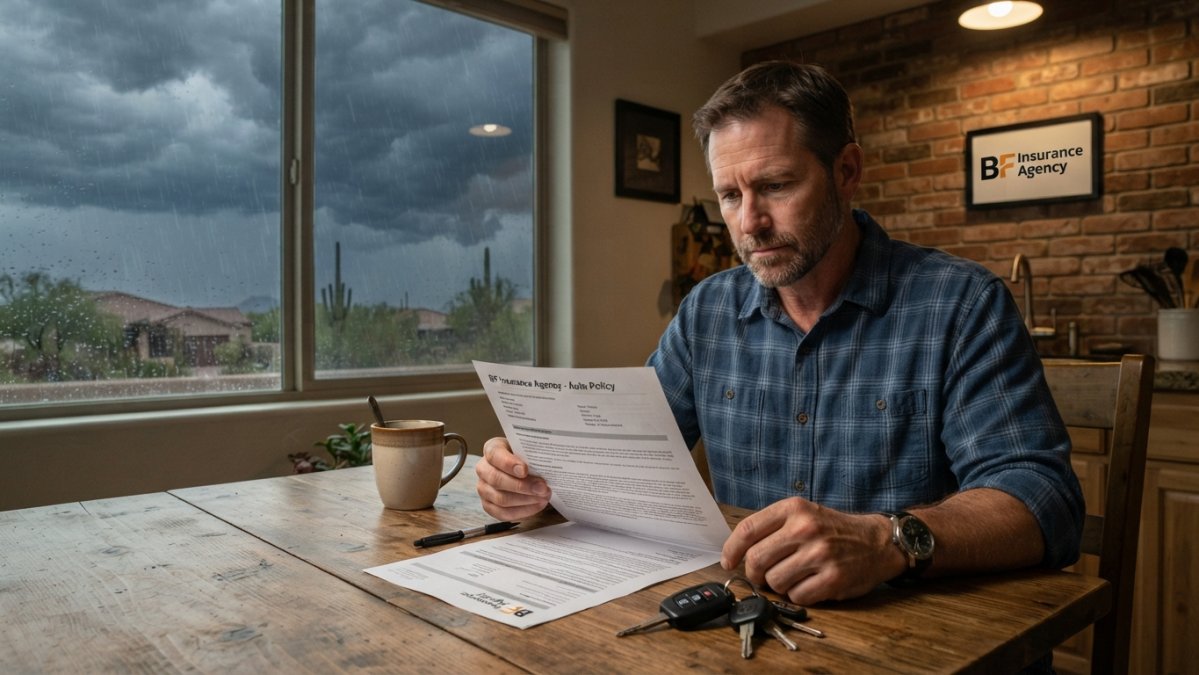
Review your comprehensive deductible before monsoon season, since a lower deductible means a smaller out-of-pocket cost after hail or flood damage, though it usually raises your premium.
Special Situations: Rideshare Driving, SR-22 Filings and Leased Cars
Personal auto policies often exclude commercial activity. Look for a rideshare endorsement or a policy written for commercial use, and confirm the coverage in writing before you start. (Source: Arizona Department of Transportation Motor Vehicle Division)
If you have had a license suspension or a serious violation, the state may require an SR-22, a certificate proving you carry the required coverage. Not every insurer files SR-22 forms, so ask about this early.
How to Compare Arizona Auto Insurance Quotes and Pick Your Coverage
Comparing quotes fairly is mostly about controlling variables. If you change limits, deductibles, or drivers between conversations, you are not comparing prices, you are comparing different products. The workflow below keeps the comparison honest and surfaces the differences that actually matter.
Step 1: Write down your coverage targets before you shop
Decide on your liability limits, whether you want uninsured and underinsured motorist coverage, whether you need collision and comprehensive, and what deductible you can comfortably pay out of pocket after a claim. Bring the same list to every quote. If your vehicle is financed or leased, pull out the contract first, the lender's requirements often exceed the state minimum and will dictate part of your policy.
Step 2: Gather the same information for every quote
Have your driver's license number, vehicle identification number, current coverage declarations page, driving history for all household drivers, and the garaging address ready. Insurers generally consider where the vehicle is parked, how far you drive annually, and who in the household has access to it when rating a policy. Leaving a household driver off a quote does not make the price real, it makes the quote inaccurate.
Step 3: Compare on more than premium
Two quotes with the same limits can differ in ways that only show up at claim time, such as parts specifications, glass deductibles, how coverages interact, and how total losses are handled. Ask each provider to explain its claims process. A lower premium with a slow, adversarial claims process is not a better value.
Step 4: Ask about discounts, and verify they apply
Insurers commonly offer discounts, which vary by insurer and are not always stackable. Ask which discounts were applied to your quote and which require action on your part. Ask which discounts were applied to the quote and which require action on your part, such as completing a course or installing a telematics device.
Step 5: Handle high-risk and SR-22 situations separately
If you have a recent at-fault accident, a serious violation, or a license suspension, standard quoting workflows may not reflect your real options. Not every insurer files SR-22 forms, so ask up front whether an insurer can file one on your behalf and how quickly, because a gap in filing can extend a suspension.
Step 6: Review before you bind
Before you pay, read the declarations page and confirm the named drivers, vehicles, limits, deductibles, and endorsements match what you asked for. Confirm the effective date and that proof of coverage will be issued immediately, Arizona requires you to be able to show it. Keep a copy in the vehicle and a digital copy on your phone.
Common mistakes to avoid
- Matching the legal minimum without checking what a serious claim would cost you personally.
- Dropping uninsured motorist coverage to shave a few dollars a month, then discovering the at-fault driver had no coverage.
- Comparing quotes with different deductibles and treating the lower premium as the better deal.
- Forgetting to list a household driver, which can lead to a denied claim later.
Bringing the same information to every conversation is the single biggest time-saver in this process. Once the variables are fixed, the differences between quotes become meaningful, and you can choose on coverage and service rather than on price alone.
The steps below summarise how to compare quotes so the comparison stays fair.
| Step | What to do | Timing |
|---|---|---|
| Write down coverage targets | Decide liability limits, uninsured/underinsured coverage, collision and comprehensive, and deductible | Before shopping |
| Gather the same information | License, VIN, current declarations page, driving history, garaging address | Before requesting quotes |
| Compare on more than premium | Check parts specs, glass deductibles, coverage interaction and total-loss handling | Every quote |
| Ask about discounts | Confirm which discounts apply and which require action | Every quote |
| Handle high-risk situations separately | Ask whether the insurer can file an SR-22 and how quickly | If applicable |
| Review before you bind | Confirm drivers, vehicles, limits, deductibles and effective date | Before paying |
Get Your Arizona Auto Insurance Quote From BF Insurance Agency
Choosing coverage is easier when you have someone to walk through the options with. If you are ready to see what your options look like, contact BF Insurance Agency to start a quote and talk through the coverage that fits your driving.
If you also need protection for a home, our Arizona home insurance coverage can be reviewed alongside your auto policy.
Frequently Asked Questions
What is the minimum auto insurance required in Arizona?
Arizona requires drivers to carry liability coverage with minimum bodily injury and property damage limits set by state law. Confirm the current amounts with the Arizona Department of Insurance and Financial Institutions before you buy.
Is full coverage required in Arizona?
Arizona law requires liability coverage. Full coverage, which adds collision and comprehensive, is usually required by lenders or lessors rather than by the state.
Does uninsured motorist coverage cost much?
The cost varies by insurer, limits and driver profile. Request quotes to see the price for your situation.
Frequently Asked Questions
What auto insurance coverage is required in Arizona?
Arizona requires drivers to carry liability insurance, which pays for injuries and property damage you cause to others in an accident. Arizona is an at-fault state under its financial responsibility laws, so the at-fault driver's liability coverage is what pays. Minimum liability limits are set by state law and can change, so confirm the current figures with the official Arizona state source or with your agent before you buy. Meeting the minimum is not always enough, which is why many drivers add higher limits and other coverages.
Is uninsured motorist coverage in Arizona worth it?
Uninsured motorist coverage pays for your injuries and, depending on the policy, certain damages when the at-fault driver has no insurance or not enough insurance. Because many drivers on the road carry only the minimum liability limits, this coverage closes a real gap in protection. Ask your agent whether your policy includes both uninsured and underinsured motorist coverage and what limits apply. Compare the premium cost against your savings and assets to decide how much to carry.
How can I compare Arizona auto insurance quotes?
Request quotes with the same coverage limits, deductibles and endorsements from each insurer so the prices are comparable. Include liability, uninsured motorist, collision and comprehensive coverage in every quote. Ask about discounts for bundling auto and home insurance, safe driving and vehicle safety features. BF Insurance Agency can gather and compare Arizona auto insurance quotes for you, but pricing depends on your driving record, vehicle and coverage choices, so request a personalized quote on the BF Insurance Agency website for current figures.
Can bundling auto and home insurance lower my premium?
Many insurers offer a multi-policy discount when you insure your car and home with the same company. The size of the savings varies by insurer, your coverage levels and your location, so the only reliable way to know is to compare a bundled quote against separate policies. Bring your current declarations pages when you request quotes so the comparison uses the same limits and deductibles. BF Insurance Agency can run both comparisons on the same coverage.